This is where the lab's operations research started — the first complex, multi-source, multi-constraint business process we trusted to an agentic workflow. It never reached the sales team it was built for, and it remains one of our most valuable experiments. Both of those facts are the story.
The problem: LinkedIn can't see a university
LinkedIn gives you tools to see who works at a company. It does not do that for colleges and universities — look up a school and you'll find the students and alumni who attended it, not the people who run it. So how does an enterprise software company selling into higher education find the influencers and key decision-makers to build a sales strategy around?
That wasn't academic. We had five sales reps covering the entire US. Our competitors had twenty-four and forty, respectively. The only way to compete at that size was to make sure our team knew who the buying influencers were — and how to make a real connection with them — before a rep ever stepped foot on campus.
The discovery: 90% wrong
When we simply asked AI to find the answers, about 90% of the data came back wrong. Confidently wrong — outdated names, invented titles, people who had never worked there. That failure defined the design requirement: an agentic workflow that put AI abilities in the key parts of the process, but ensured the process ran consistently every time and returned only verifiable data. AI where judgment is needed; determinism everywhere else; verification before anything is written down. Every operations experiment this lab has run since is an evolution of that rule.
The machine
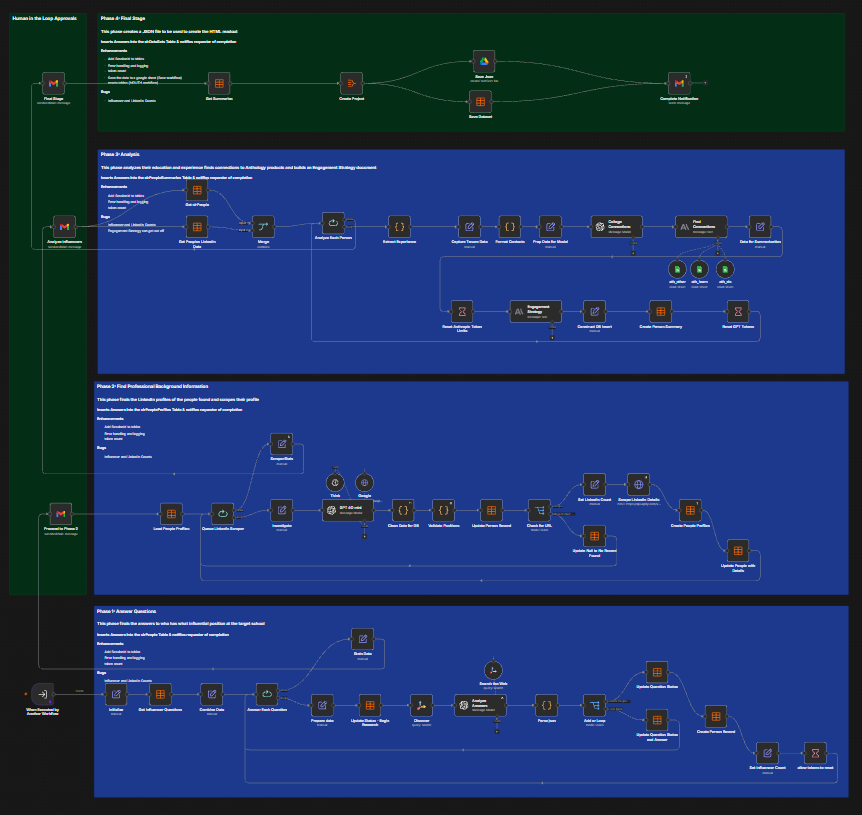
| Phase | What it does |
|---|---|
| 1 · Answer questions | Takes a target institution and works a configurable question bank — who is the CIO, the Registrar, the IT and finance leadership — using web search plus AI analysis, and keeps only names it can validate as current. |
| 2 · Professional background | Finds each person's LinkedIn profile through layered search strategies, then extracts the professional record — including working through the Experience array to establish current role and tenure. |
| 3 · Analysis | Matches each prospect's education and experience against current customer records across a library of over 60 products and the institutions they had connections with — who already knows our products, who influences whom. |
| 4 · Final stage | Assembles the intelligence into a styled report — executive summary, prospect profiles, per-person engagement strategy — and delivers it. |
| Every phase | Human in the loop by design: each phase halts for approval before the next spends a dollar or an API call on unverified names. |
The constraints were the education
The workflow's shape came less from the AI than from everything around it:
- Google API write quotas capped how fast results could land in storage.
- LLM token limits dictated how data had to be chunked, summarized, and passed between steps.
- The LinkedIn Experience array — parsing a person's real current role and tenure out of messy, inconsistent profile data.
- Customer-record matching at scale — a 60+ product library crossed against every institution a prospect had touched.
- Required wait times to stay inside all of the above meant a full run took over 40 minutes start to finish.
That 40 minutes is the honest number, and it's also the point: in 2025, making a complex process reliable meant deliberately slowing it down to the speed its weakest constraint allowed.
The ending
When the system was finally built and complete, the company declared bankruptcy. It was never handed to the sales team that needed it.
But the experiment succeeded at what mattered most: it taught us exactly how complex processes with multiple data sources and different technology limitations impact the whole — where AI earns its place in a business process, where determinism must hold the line, and what verification discipline costs. That education became the pattern behind everything on the operations research line, and the agentic workflow approach it pioneered now ships commercially at QuickLaunch.
Benchmark · Concluded 2025